
Development of Nanoparticle Synthesis Techniques
M ultiferroic materials, with both electrically distorted perovskite structure and magnetic ordering, have become promising materials due to their multifunctional properties. These extraordinary properties make them potential candidates in cutting-edge fields including spintronics, switchable spin valves, high frequency filters and sensors.
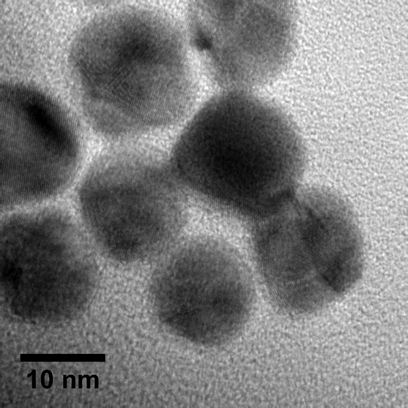
The aim of this research project is to introduce a cost effective, simple top-down approach to prepare ultrafine multiferroic as well as manganite nanoparticles directly from bulk powder without using any chemical solution processes as well as toxic precursors. Recently, we have developed a technique for the synthesis of Bi based Bi0.9Gd0.1Fe1-xTixO3 nanoparticles by ultrasonication of their micro-meter sized multiferroic bulk powder materials with size determined by sonication time. Transmission electron microscopy imaging confirmed the formation of single crystalline nanoparticles with a mean size of 11-13 nm for 60 minutes sonication. The utilization of ultrasonic energy in a process called sonofragmentation offers a facile, versatile synthetic tool for nanostructured materials that are often unavailable by conventional methods. Ultrasonic dispersion is extensively use to disperse sub-micron agglomerated powders in liquid suspensions. It is possible to break down the aggregates of nanocrystalline particles by using the multiple effects of ultrasound which generates many localized hot spots with the particles within the solution and during the process, the implosive collapse of the bubble causes an inward rush of liquid known as ‘microstreaming’ in which high velocity is produced. Thus the agglomerations can be broken down utilizing the effects of ultrasound , resulting in reduction of particle size. By using ultrasonic energy, we have also produced nanoparticles of rare earth based complex perovskite manganites. To evaluate the potential of rare-earth based novel manganite nanostructures for future technical applications, the knowledge of their synthesis and the correlation of their structural and magnetic properties are essential. We believe that the demonstrated ultrasonication technique may be promising for fabrication of other rare-earth based manganite nanoparticles and can be further developed as a versatile technique for the preparation of nanoparticles of a wide range of materials.
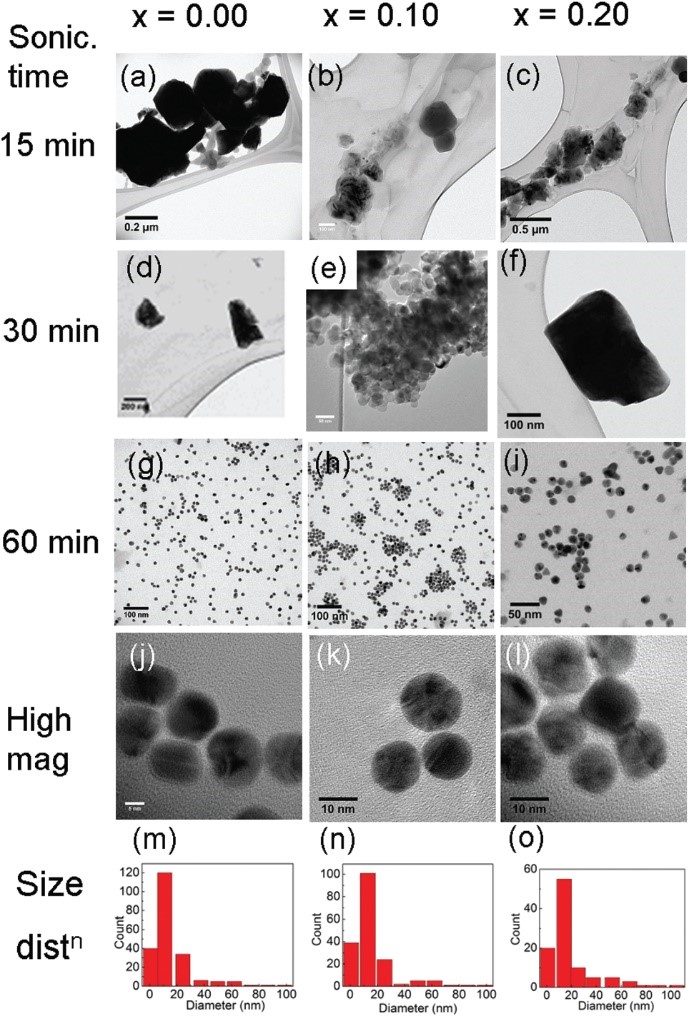
Fig. 1 BF TEM images of the Bi0.9Gd0.1Fe1−xTixO3 (x = 0.00–0.20) particles obtained at various sonication times: (a–c) 15 minutes, (d–f ) 30 minutes, (g–i) 60 minutes. ( j, k and l) are the HRTEM images obtained at 60 minutes of sonication. The plots (m, n and o) show distribution of nanoparticles deduced from frames (g, h and i), respectively.
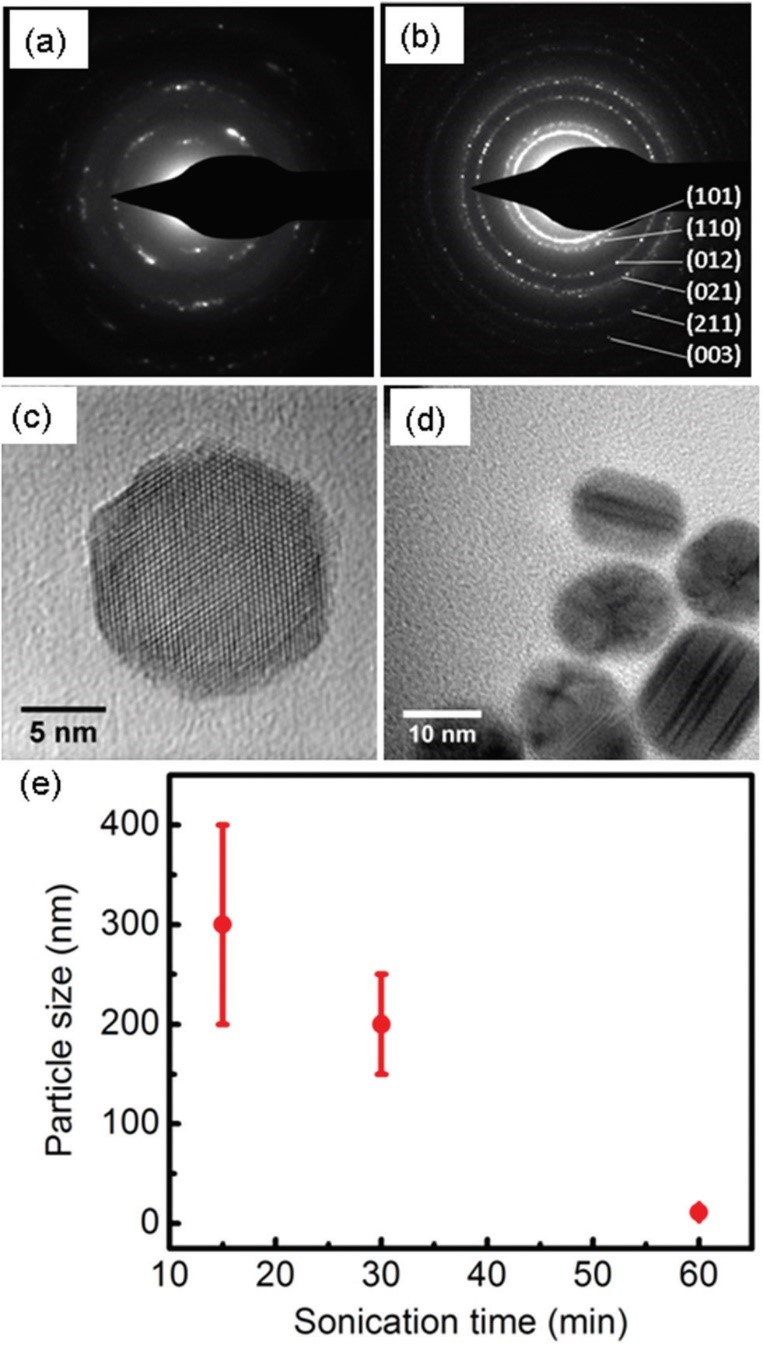
Fig. 2 (a) The SAED patterns of the Bi0.9Gd0.1Fe1−xTixO3 (x = 0.0) particles sonicated for 30 minutes showing discontinuous rings. Detailed TEM investigation of the Bi0.9Gd0.1Fe1−xTixO3 (x = 0.00) nanoparticle (first column in Fig. 1) sonicated for 60 minutes are given in images (b–d). (b) SAED of nanoparticles showing multiple peaks of monocrystalline patterns. (c) HRTEM image showing monocrystalline particles. (d) HRTEM image showing twin stacking in single particles. (e) The variation of particle size as a function of sonication time for a fixed sonication power.
Selected publications based on this project:
1. Simple top-down preparation of magnetic BiFeO3 nanoparticles by ultrasonication of multiferroic bulk material.
M. A. Basith, D. T. Ngo, A. Quader, M. A. Rahman, B. L. Sinha, Bashir Ahmmad, Fumihiko Hirose, K. Mølhave.
2. Large difference between magnetic properties of Bi and Ti co-doped multiferroic and their corresponding nanoparticles prepared by ultrasonication.
Bashir Ahmmad, Kensuke Nakamura, Kunio Hirota, Hiroaki Kato, Fumihiko Hirose.
3. Tunable exchange bias effect in magnetic BiFeO3 nanoparticles at temperature up to 250 K.
M. A. Basith, F. A. Khan, Bashir Ahmmad, Shigeru Kubota, Fumihiko Hirose.